
'His negotiations with Idi Amin and his men for compensation for the Indians, who left Uganda, were particularly tough. Apparently, Amin warned him that the body of the British negotiator, who came earlier, was found in a roadside gutter... As Jagat Mehta's special assistant during the last two years of his tenure as foreign secretary, I saw for myself how his conviction, courage and patriotism enabled him to fight against heavy odds, says Ambassador T P Sreenivasan.

'If you invest your entire capital in talks, you cannot abruptly change gear and decide on war.'

'To consider BRICS anything more than a temporary club with some common interests would be folly. The goal should be to induce others (Japan, ASEAN, South Africa) to align with us -- a non-threatening, democratic nation, rather than with malevolent China or waning America. For us to consider aligning with either China or the US would be absurd. India is just too big to be a sidekick,' says Rajeev Srinivasan.

'Clearly, from the Indian viewpoint, the US retrenchment from Asia cannot be happening as good news.' 'The abandonment of the US' pivot to Asia exposes the US-Indian partnership to be a mere transactional relationship,' says Ambassador M K Bhadrakumar

'Of the 32 captains who have led India in Test cricket, only four have been pure bowlers -- Ghulam Ahmed, Venkatraghavan, Bishan Bedi and myself.' 'The captain must lead with only one idea in mind -- to win the game. The draw mentality is partly because captains lacked confidence and partly because they want to protect their record. If you don't think winning is the point of the game, there is little point in even entering the field.' 'As the Monekygate controversy raged, I received a message from Bishen Bedi, no stranger to controversies himself. "As a captain," he wrote, "take a decision you will be proud of when you look back on history".' Anil Kumble, cricketing legend, on the Art of Captaincy.

A journalist must perform various roles, be passionate yet detached, feels Gopalkrishna Gandhi

'Nehru had multiple chances to make compromises, that would have preserved a united India, and he chose not to,' Nisid Hajari tells Vaihayasi Pande Daniel/Rediff.com
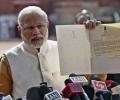
he has to demonstrate the ability of his government to take a quantum leap, almost tantamount to setting the Ganga on fire, in the next six months, if not in 100 days, if the people were to take seriously the cascade of commitments spewing out of the President's address to both Houses of Parliament on June 9, says B S Raghavan. B S Raghavan suggests five practical propositions through which the Modi government can bring in paradigm changes.
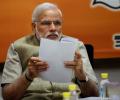
In the final part of his interview with Sheela Bhatt/Rediff.com, journalist Rajdeep Sardesai says the Congress lost the election in 2011, the year of Anna Hazare.

'Modi, focused on youth and their aspirations, has articulated a truly disruptive change: One of hope, of duties rather than rights, of standing up to the world instead of being bullied by it,' says Rajeev Srinivasan.

Upstaged by the swanky malls in town, both M G Road and Brigade Road have lost their "happening" status

Atal Bihari Vajpayee would seek to placate the hawks in the RSS by stating that the writing of history should not be one-sided. At the same time, he would project a moderate 'Nehruvian' image of himself as the archetypal liberal politician who would strive to attain a balance between conflicting viewpoints. A fascinating profile of the former prime minister and Bharat Ratna by Paranjoy Guha Thakurta and Shankar Raghuraman.

Mahesh Rangarajan, director of the historic Nehru Memorial Museum and Library in New Delhi, tells Sheela Bhatt how the first prime minister will always remain relevant, and the efforts being made to keep his legacy alive.
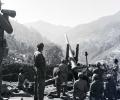
Fifty years ago, India and Pakistan fought a short but bloody war. The author finds out how Sainik Samachar, the defence ministry's journal, reported it.

'The real test will be in defence-related deals, for instance the Javelin anti-tank missile: Is the US willing to co-develop something with India, on terms that will support the 'Make in India' initiative? Is there defence technology transfer? Or will it dump old junk on India?' asks Rajeev Srinivasan.

'We saw how vigorous democracy was when it dislodged authoritarianism under Indira Gandhi. We saw its vigour again when it voted Mr Modi out of humble origins as prime minister. It was Nehru who laid that foundation for India and what is worrying today is Modi's rather imperial style of functioning,' says writer Nayantara Sahgal.
